My days involve walking. I'm walking at least 10km a day. Mostly that is early morning, late in the afternoon, when it is cooler. Middle of the day, I visit a library to charge my phone. Then sit either outdoors or in a mall our shopping center, have my daily meal while people watching, day dreaming, or watching the wildlife. Sometimes I talk with people. Mostly it's the elderly.
I've walked a few trails and suburbs that I've not been to before. Some nice walks about. Many more to explore yet. Though, I want to carry less to do it.
Doing a bit of community service. Walking past the same rubbish every day got to me. Someone should pick it up. I decided to be that someone. Starting carrying a bag and picking it up. I'm only filling one shopping bag a walk past, so will be cleaning some places for a while yet. Been reporting leaking taps/toilets to the council, water seeps to Sydney water, etc. I don't get why the people who clean/resupply the toilets don't report leaks. Such a waste water!
Still bedding down living. Finding water locations, open toilets, sleeping spots. Got very dehydrated a few times not drinking enough. Combination of few water fountains and fear of not finding a toilet when needed. (Also being in to populated areas with few bushes.) And just not thinking about drinking. Making an effort to drink more.
Still hunting the perfect sleeping spot. Had a couple of sleepless nights with bad choices. But it's been okay overall. The weather has been fine this past week. Any showers were light and after I was set up. Was a couple of heavy dew falls too. Sooner or latter will be heavier rain. I hope to have sleeping sorted before then. Or, might try for undercover. Wet gear is heavy, and I carry it outside my pack to keep the rest of my stuff dry. If it's only lightly damp, I leave it. But if it's dripping wet, I spread it out at lunch time to dry.
Pack weight has plummeted. Carrying everything everywhere really has me focused on having less. Down from 8 or 9kg to about 5.5kg now, including the pack. I changed to a smaller, lighter 45L pack, but it's not full, so I could go smaller yet. I'm not happy with the gear I am carrying, and am experimenting to drop it further. There are some trade-offs. I'm finding that some of the trade-offs are more mental than physical with comfort. And some of the physical comforts after a while you get used to having less. It's just the change that feels uncomfortable.
I'm changing my clothing. The long sleeve shirts and cycling shorts aren't as utilitarian as I'd like. Sweating in them walking, the shirts are large and difficult to wash. I'm trialling a layering system, so I can wash the thin, light, quick dry base layers more often, and the outer layers, hopefully less often.
Wipes were on sale and I purchased a packet to try. Washing with wipes does feel better. But having a water shower still wins out. I had one this week. Washed my clothes under a tap at the same time. Midday in the sun, 34C, it all dried in an hour. I spread things on a park bench at first. Then draped first the shirt, then later the pants, on my head, both to cool me and to dry them faster. Next time will just wash and wear. It's faster that way. I don't want to pack away damp clothing as it will not dry in my pack.
I needed to leave my friend's house sit. The plan was to walk south, and I did start. But, as they do, plans change. Now I'm staying about the Sydney region for a bit, living out of my pack.
The day is dawning. It's raining again. Showers really. I'm grateful to be dry for now. I've spent a lot of time damp and will be again. My morning dilemma: wait for the shower to pass or pack and head off in the rain to find an open toilet? Not many public toilets are open overnight. Not good to wait too long. Whichever, I can't stay here too long. No one it's about in the rain, but they'll come. I can't be seen here.
My travel by bicycle, I now look back on thinking it was so easy. Lots of space. Set up a tent! Dig a cat hole. Strip and wash under a bottle shower. Air dry. Sun bake. Hang out in camp. Stay clean. Carry lots of food and water. Always going somewhere, or doing something. Find food, water, campsite, a change of scenery. Never many people around. When I started out it was terrifying. I had so many fears. It only got comfortable and easy with time and experience. I'm in the same place now. The fearful, terrifying place. Still working out how to deal with everyday issues. Where to sleep, toilet, get water, wash myself and my clothing, where to hang out at 6am when I can't stay in my bed. Where to wait till it gets dark enough to go to my bed. With time and experience I hope it'll get easy. But that's little consolation now.
Only last night I slept well. But I think it was just lack of sleep catching up with me. I want more sleep. I had found a place for a few nights. But rested uneasy, waking often. I like the spot, but I'm too conspicuous there. Soon someone will notice and I'll get rousted, maybe risk getting fined. I need a better spot. Another motivator is that if the rain continues today, my spot will be very muddy, if not under water. Definitely somewhere new tonight. My wish for a quite spot has waned as I've become more accustomed to the city noise you don't notice inside: cars, trucks, dogs, people talking, planes taking off/landing. Noise I can handle. To sleep undisturbed is what I want.
Washing is still on the list to solve. Cycling, my clothes didn't smell. I'd sweat and dry and my skin would get a layer of salt. Clothes got salty. I think the salt stopped the bacteria that cause smell. Walking, I sweat, but stay damp, and don't salt up. Clothes start to smell. A quick rinse in a sink and put them back on wet is not enough to clean them. Wash and wear I call it. Even with the cool days and showers they dry eventually. Bit unpleasant putting them on, but it quickly passes. I need to get soap for the next wash. Need to wash me too.
I decided to wait out the current shower and use it to wash out my socks. The toilet, not yet urgent enough and perhaps not open either. I'll enjoy the time without having to move just a little bit longer.
Once already I've downsized my pack. The easy discards. I thought I was being ruthless then. Further days have shown me my errors. I've still too much useless stuff. Each possession is mentally weighed. How essential it is now? Few things are. Extra clothing for cooler weather will be essential, but not now. It'll go. Weight and bulk are my pack enemies. Even the pack taunts me with its size and weight. It's day is coming. A heavy pack is awkward. Stands out. Hard on the body too. Full of useless stuff, I cannot fit more essential items. Or can't easily find what I want without emptying it. I've though about a shopping cart, but want the freedom of walking for now.
The day ahead is large and empty. Sunrise is about 6, sunset about 8. What's open when and where. How to get there. How will I fill my day?
The return trip was without the cart; carrying everything. Total carry weight was about 22 kg. Of that 12.5 kg was water with 10 L in one container. It quickly got old carrying that one: both arms in front, left arm, right arm. Even tried sitting it on my head for a bit. Was very thankful that the walking in was over. The cart, for the problems it had, was definitely better for transporting a load.
Followed my own advice and had less gear, so walking around without the water was a lot easier. Total pack weight was less than 9kg. I left behind items that in the past I'd considered essential. Less clothing, less food, less camp items. It wasn't as uncomfortable as I thought it might be, and more after a few more test camps it settings normal. While there, I tested some other ideas; wearing less clothing to sleep and sleeping mat size. The outcome was that I now cut my sleeping mat shown to torso length, and I no longer carry a set of thermals.
My bug net wasn't midge proof. It was only for mosquito. It was also getting rather a lot of holes in it. After much deliberation I ordered a tent. 750gm total with tent pegs. But it does need a hiking pole to erect it. Spacious it isn't. Body bag or coffin comes to mind. It seemed a good idea at the time. Lots of testing showed it wanted perfectly flat ground to put it up. I have doubts that the fly is the same model as the inner. But I did figure out how to put it up. The first night I used it, I was glad to be in it when it started raining. Lying there, I couldn't imaging trying to get in if it was raining, or pack up in the rain. I threw out the fly and returned to using the tarp. The inner I've kept and use under the tarp. The tarp has a lot of space under it, and I can put it up fast. When it's raining, put the tarp up first, then hang out under it in the dry. Set up the bug net, spread out wet gear. Packing up is the reverse. Easy peasy.
I've been on the road a few days now living out of my pack. It still needs some more tweeking. I still have too much gear with me. And I think I can do better with what I do have. As in change it for something else or use it differently to how I am currently.
Headed off for a few days to test some gear and to explore the area where I was to camping a bit more. The gear test happened, the explore - no so much. I'd forgotten about holidays. There seemed to be some events happening so I mostly stayed to one corner of the area and watched the passing traffic.
Gear tested:
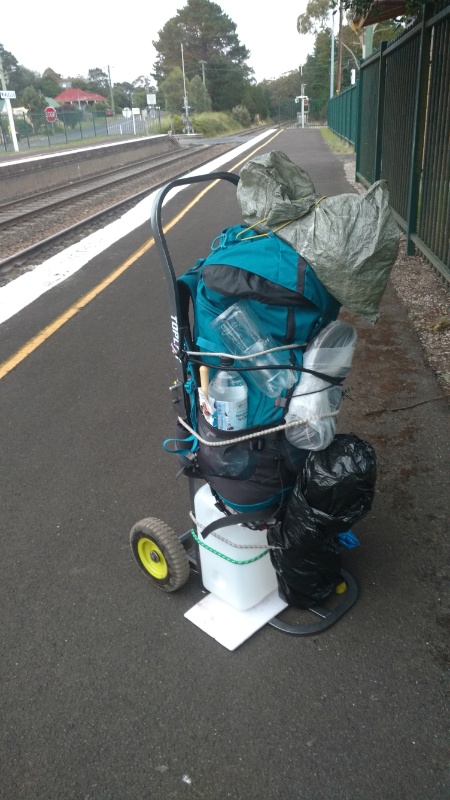
The cart is small - not much larger than a "seniors shopping cart". It has done a few trips with me about the suburbs, though, with how I load it, it looks less like a shopping cart, and more like a homeless persons'.
The main reason for using this cart is it is not much larger than a shopping cart and that it can fold down. A bonus is that wheels are gel filled - so no punctures. It has a weight capacity of 200kg, but my load was more modest. The picture to the left shows it with 20 litres of water capacity on the bottom and my newish pack sitting on top. On the outbound trip there was nothing strapped on the outside. But the sudden realisation just at 5am that I had less than an hour to pack and make my way to the distant train station, meant packing shortcuts. Surprisingly nothing fell off while running on bush tracks and corrugated dirt roads.
The cart worked surprisingly well. Total load was approximately 40kg including the cart. The 8" wheels handled the bitumen and dirt roads, soft sand and across country hauling without too much resistance. Larger wheels are better and I had hopped, but the larger diameter wheeled carts didn't fold and were much larger and heavier. Pushing the cart was preferable. But pulling was better over rough ground or on steep uphills. I was able to easily drag the cart fully loaded over downed trees. The downside of pulling was it was best to be facing backwards and pulling the cart. Facing forward and pulling the cart behind - unless done always with two hands on the cart, resulted in a twisting force on the body. My knees complained after I pulled it one handed over obstacles.
More thought is needed on the cart use for offroad use. I liked not carrying the weight. But the cart weight is fixed and moving it involved a certain amount of effort and course selection. With less gear, could I have carried the my gear and water, and not had the cart? I plan to repeat the trip soon - while the weather is similar and test the idea.
My newish 65L pack was an $80 impulse buy. Initially it seemed an great deal. With more time and use, I have some dissatisfaction with it. One issue is that to use the outside pockets - unless for small items - they require space from the main body of the pack. From the above picture - if the main body of the pack was packed tight - then the water bottle would not fit. I could (and might) cut the fabric and add more material in to stop this. The rear mesh pocket is so small as to be almost useless. I added several tap loops and elastic cord to be able to hold items in this pocket. There are other pockets - that also remove space from the internal body of the pack - not so handy I think. Added weight without much benefit. The internal frame is a solitary stay in the center of the pack. While this seemed okay at first, it doesn't distribute the weight as well as having two stays. I've thought of moving the centre stay and adding a second, but haven't yet. It may be better to just replace this pack than do to extensive modifications. I did however make some other small modifications. It had a small pocket on the side of the hipbelt. I cut this off and reattached it further forward on the belt. Where it was located, my arm hit it with each swing of my arm. My greatest addition was to the base of the pack where I crafted a pouch with several velcro closing pockets. It added three separate carry locations. Unfortunately, while it seemed a great idea, and took me a long time to sew up, using it wasn't so great. The material was too heavy for what was needed, and the velcro not easy to open and close. I removed it on returning as it added too much weight for little benefit. I'll have another attempt using lighter fabric and either elastic closures or a zipper.
My sleeping bag from the Bibbulmun track walk had a meeting with the scissors. I nearly always use a sleeping bag like a quilt - as I move about a lot and find zipped up sleeping bags too confining. It weighted 1067 grams without the stuff sack. (I don't use the stuff sack.) After meeting the scissors, it weighted 683 grams. I cut off the hood, zippers and zipper baffles to turn it into a flat quilt. While on the camp, I sewed the foot box up again. I found I liked having a foot box. Without it, I kept poking my feet out the bottom. I didn't add straps to hold the quilt down - so more care was needed rolling over. The zipper and baffles did help keep the edges of the bag down. I might add straps in the future. I might also add a closure for the top. I like the lighter weight of the quilt, but as I'm still using it with a lap rug when the temps drop towards (and below) 10C, there is still room for improvement here. It will do for summer use with temps greater than 10C.
The other gear change was not taking gear. Even so, with culling down what I wanted to take, I still ended up with necessary gear adding weight and bulk. Sitting in my shelter on the second night looking at the stuff I had, too much of it was unnecessary. I keep packing "comfort items" - items that I don't really need, don't add comfort, add weight and bulk, but that seem vitally important when thinking about what "might be needed".
I wasn't certain if I'd like walking with a pack, so I didn't want to spend a lot of money on gear that I might not use again. I've also a reluctance to buy expensive gear if something cheaper does the job "good enough". Spending more money doesn't necessarily mean better or guarantee the best experience. This is the gear I used. It may not work for you, but it might give you some ideas of what is possible. I'm not listing everything I carried, just the main items.
I had camped before, but in my bicycle traveling days I was a big pack rat - 40kg of gear. This was my first backpacking trip and I made an effort to cut the weight down. Lighter is better, especially when carrying it on the back. My base weight was about 10kg. This is everything in the pack, including the pack, except consumables: food, fuel (that I didn't have), water, etc. I could have been lighter, but had 'spare items' or 'backup items' in case something failed or didn't work. I had stuff that strictly wasn't needed for the whole hike. eg I carried all the maps after the first resupply all the way to the end. Others discarded used maps, or only had the map for the current section. I also had stuff that at the end of the hike I hadn't used at all, that with more experience wouldn't have been taken in the first place. So there was room to lighten my load. There were lighter base weight hikers. They were more experienced hikers, (some having hiked the Bibbulmun track multiple times already), were not carrying tents. They had spent significantly more on their equipment. Another strategy used was to use a bounce box. Mailing a box ahead to the next town, with items not need for that section. eg. town clothes, maps, etc.
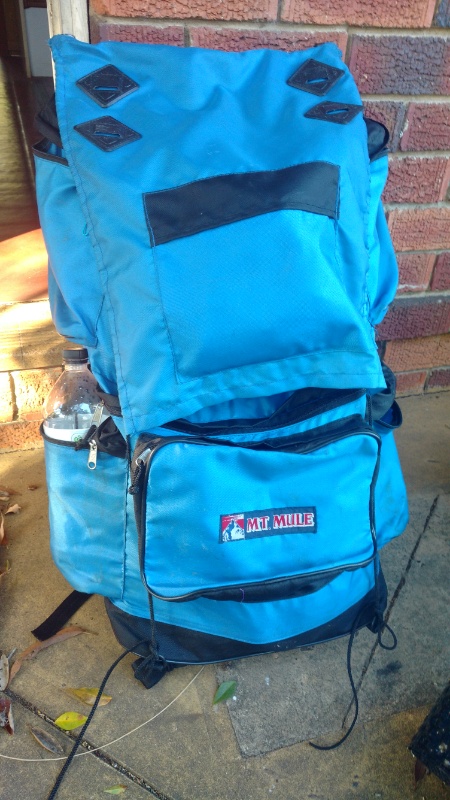
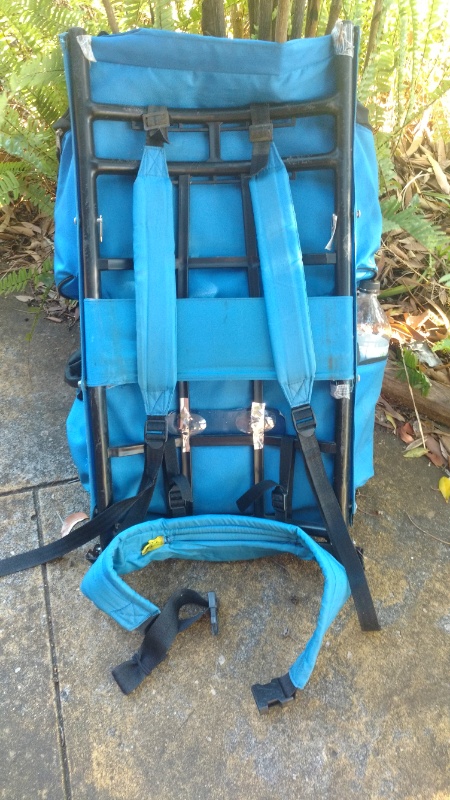
My pack was an old external frame "Mountain Mule" pack - last made in the 60's or 70's I was told by some of the more knowledgeable (read: older) hikers. I'd found it on the curb during a council cleanup. Someone threw it out! The straps were set up weird. I never did figure out who could have used it: man, woman or child. I adjusted all the straps to get it to fit and be comfortable. Other than adjustments, I did minimal changes: added some small bits of plastic to cover a couple of sharp points that I worried might catch on my shirt. That was it. On the trail, I had to sew patch the hip belt attachment point after a fall broke some of the stitching. I did this twice as the first time my stitching pulled though. The second time I added a small bit of webbing to reinforce the point. In the photo it is the small bit of yellow on the hipbelt.
The main bag is in two separate compartments. The bottom with a zipper, the top with a draw string closure, with a top flap cover that uses string to tie it closed to the bottom of the pack. There are two side pockets with zippers per side. I kept water bottles in these. There is one small pocket on the top flap cover with a simple material fold closure. This I used for my rubbish bag. There is a small zippered pocket on the bottom compartment.
Overall I was happy with the pack. It was comfortable, though as the hike progressed the hipbelt started to break down as the internal foam collapsed most likely because of its age. This caused it to press a bit more in some places than others. Without a rest break it would get bothersome and I'd move the hipbelt about to have the spot press a new location.
I didn't like the two separate compartments as it was sometimes difficult to fully pack the bottom zippered compartment. I didn't want to overstuff the compartment as I was worried that stitching might fail and leave me with a repair on the trail. So it often had empty space that I thought could have been used better if the bag was one large compartment.
Wet weather protection was a garbage bag in each compartment. Nothing in the bags got wet. Put the garbage bag in and pack gear into it. Important items also were in dry bags. I didn't want to using dry bags as they are heavier than garbage bags, but I had them, and they were my backup option if the pack material failed because of age. I had three 20L dry bags. The backup plan was that everything could fit in dry bags, and I'd tie them to the frame with the ample cord that I had, and then be able to keep going on the hike. Overall one was for food, one for sleeping gear/clothing and the third for electronics. 20L bags were too big and full they wouldn't fit in the pack compartments, so day to day everything didn't go in them. Hence needing the garbage bags for waterproofing. Electronics was the only item that consistently ended up in a dry bag. On days with no chance of rain, the dry bags were sometimes not used at all -just rolled up and packed with everything just in the compartments. The pack had minimal material - so even with it getting wet it dried out quickly.
Annoyances: the lack of easily accessible small pockets with the pack on. Accessing anything, I had to take the pack off. I used the side pockets for water: bags empty or full, a PET bottle and a water filter. Apart from a tube of chaff cream in a side pocket, everything else had to be accessed in the top compartment - undo the strings, open the drawstring, and then open whatever bag was needed. I wanted a small bag at the front - like a bum bag - to keep stuff like snacks, phone, etc. As it was I only had my shirt pockets.
I tried the sleeping mats (see below) on top of the bag - annoying to open the top compartment. Underneath - meant the bag wouldn't sit up when you put it down. Lastly, vertically at the back. This worked the best. The bag would sit up vertically and I could access the top compartment. It also gave a narrower profile - which was important for fitting through some gaps between trees.
I'd be classed as a side sleeper. I can fall asleep on a hardwood floor, so a thin CCF foam mat is sufficient for me. My CCF foam pad from K-Mart: $8 or $10. The sleeping mat insulates you from the ground and is very important for sleeping warm. You can lose a lot of heat downwards by conduction. From my bicycle travelling days, I knew I could use a foam mat happily no matter how compressed, unless it was below 10C and especially not on rock or cement. In those cases, one mat isn't thick enough insulation. I'd not tested on a wooden platform, but guessed that it would not be a problem as wood is more of an insulator than rock or cement. Ground sleeping I'd find the 'soft spot' - on leaf litter - which is a good insulator if thick enough. The Kmart mats compress over time. I use them nightly - even when staying with friends or in hotels or cabins; I still sleep on the floor with a mat. The pad I took, I'd used nightly for several months before the hike started and it had collapsed a bit. It continued to collapse, and I found the wooden platforms cooler than I had though. At my first resupply I got a second pad (that had even more nights use on it) and doubled them up. Near the end of the hike, the second pad was doubled up on itself and only used under my torso. So effectively I had three layers of pad under my torso. But it was still thinner than a new pad. By this time the overnight temps were warmer, but next time I would start with a newer Kmart pad. Carrying two pads - even though they had compressed was still bulky compared to one new pad.
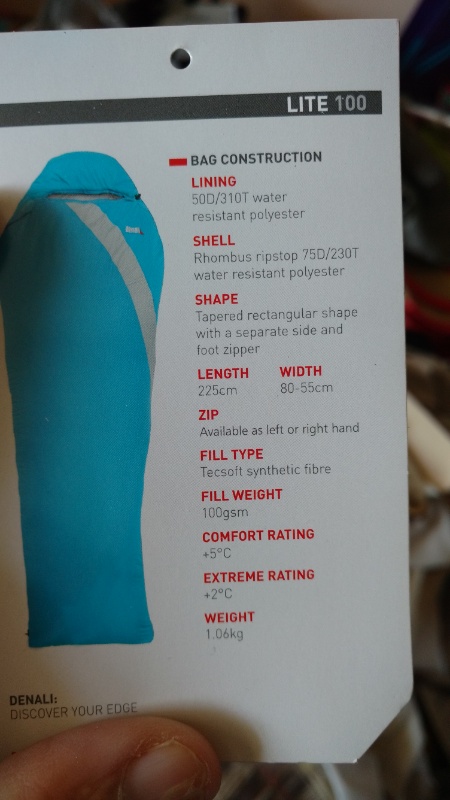
Sleeping bag was a 1.06kg $85 (on sale) synthetic bag from Anaconda. Only purchased as my usual Kmart Summer bag isn't rated below 10C and that was expected. I didn't take the stuff sack with me - but squashed it into a $10 Kmart 20L dry bag (that would have weighed more), or just into the bottom compartment in a garbage bag. I didn't use a bag liner - sleeping in thermals, light clothing or everything at one point early on. I also rarely used the bag as a bag - using it as a quilt over the top of me. I sprawl about sleeping, and find zipped up bags confining. But if cold, would try zipped up. Not as good as a quilt - as the bag has different thicknesses on the "bottom" and the "top". Also the hood was not that useful, or the baffles about the top and to seal around the zipper. So it is heavier than a quilt would be.
Initially I had problems with waking up cool - usually just after midnight and continuing till morning. The first two weeks were spent trying different combinations of sleep wear and bag zipped up or open, to try and work out why. The first resupply I had a second sleeping bag for one night as a further test. A $12 Kmart synthetic summer bag that I use on the east coast. I spread it over the top to increase the warmth. It didn't help. The conclusion I come to was that the Anaconda bag wasn't breathing well - so moisture couldn't escape, I'd eventually get damp, and then chilled and wake up. Trying to leave vent gaps just let in cool air. It wasn't bad enough to want to stop hiking, but it was mildly annoying. Adding a small (127 cm x 130 cm) $7 synthetic lap blanket purchased in Dwellingup shop - improved sleeping comfort immeasurably and I never woke cold again. This weighed 330 grams. I still used the bag as a quilt. Coldest night was then about 2C, and I just slept in light clothing and was toasty arm. So with thermals and clothing I would have been able to sleep in lower temps. I used the blanket in camp as a cape - wrapped around me sitting or standing for warmth at times. After getting the blanket I discarded my op shop fleece jumper in Balingup to free up pack space - as I found the blanket was smaller, lighter, warmer and more useful.
I didn't take a stove or cooking pot. I was "no cook". Reason for this was to save weight and pack space. I've been "no cook" in the past bicycle travelling, so knew it wouldn't be a problem for the trip. Food was purchased in towns as needed. Except for a parcel send by a friend to Donnelly River Village I didn't have mailed resupply. The parcel was to resupply for the next five days - but due to a miscommunication, the food was unsatisfactory, so I discarded most of it and used left overs and items purchased at Donnelly River Village to get to Pemberton. It was minimal rations for that section and I was hungry on arrival.
My method was generally wake up, pack up and start walking. Get to the shelter and eat, which was usually about lunch time. Save something for a bit of a snack closer to evening, but eat most of the food for lunch. Sometimes I planned a snack before lunch or had a "breakfast", but most times didn't. Various trail mixtures, peanuts, cashews, almonds and chocolate was the main food items. Muesli, oats, sultanas, tinned fish, packet fish, snack bars also had an appearance at different times. Trail mix and chocolate was a reliable resupply. Calorie dense food. A block of chocolate is about 1000 calories. Trail mix was about 2000 calories. Together they weighed about 600 grams. I always planned to eat before leaving town - so only needed an afternoon snack for that day. The day arriving in town, the plan was to have no food left for that day as I would eat on arriving in town. With unplanned double hutting or not eating enough, only once did I get into town with nothing left.
My tent was a silpoly 3x3 meter tarp with a Sea to Summit nano bug net with a plastic groundsheet. Using trekking poles, I could put this up "free standing". But usually I'd use a tree or two. I'd used this previously so was comfortable with it. On the trail I used it a few times - when shelters were full or when I wanted to camp away from the shelter. I carried way too much cordage with me. Some was for the fall back pack mending with dry bags option. But even then, I had more than I needed, and I gathered more cordage that I found discarded at camp sites.
Trekking poles were some ebay $16 items. Nothing special about them. I had to mend one with epoxy in Dwelling up as the hand grip was slipping. I definitely found the poles useful for walking. Helped with balance especially when wading through water or walking on clay. My one fall, was on clay, and the poles slipped out also. I had the rubber tips on, when it would have been more sensible to have removed them. I did prefer the rubber tips on though - they didn't sink into the ground as much. But after the fall, I did the rubber tips when on long clay sections.
Clothes were op-shop or low cost K-mart purchases - apart from shoes and socks. I had the clothing I was walking in, thermals and clothing to sleeping in, and a town set. Long trousers would have been better for the coastal section as the brush there is scratchy. More on this below.
Footwear generates a lot of discussion. The "you need boots - thick, strong, waterproof, ankle support, high laces, etc." seem the most vocal. People do use trail runners or joggers. Online I've read of barefoot hikers. Other hikers wore a mixture of boots, shoes, insoles. Some had problems with blisters, or soreness in various parts of the foot some didn't. Find what works for you.
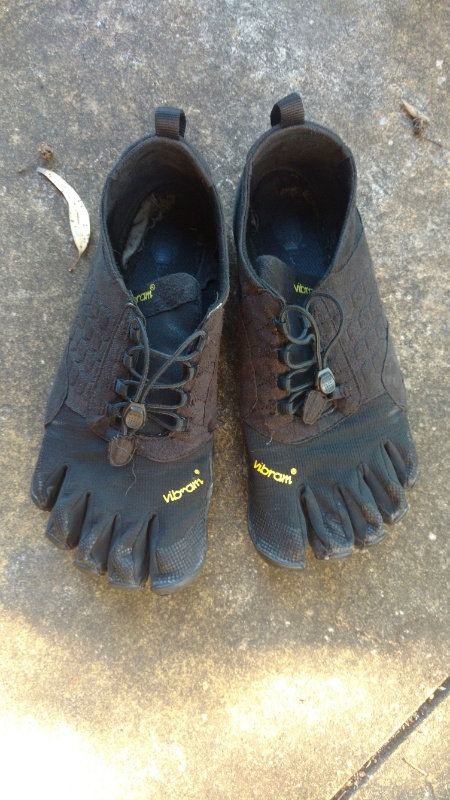
My shoes and socks were different and gathered a lot of comments on and off trail. Apart from electronics, they are my most expensive purchase. Vibram Five Fingers. Also known as "barefoot shoes". This model is the "Trek Ascent" with a 4mm layer of rubber, and a 4mm insole. Total of 8mm. Thin enough to feel what you are walking on. Vibrams are not waterproof. Water enters and leaves fast. This was an advantage in the wet and water wading sections. But equally, morning dew or just wet ground would leave me with wet socks.
Socks, unsurprisingly, need to be toe socks. Injini are the goto brand and usually found about $20 a pair.
I've worn Vibram Five Fingers before. Do take notice of the need to change gradually. Most shoes that people wear have the heel raised. Five Fingers don't - they are known as zero drop shoes (The "drop" is a measure of the heel to top drop). Changing from a heel to zero drop suddenly can cause problems as the body needs to adjust to the change. While they were not my
first choice
they were what I ended up walking in. They worked well for me. I started with an older pair (size 44) and switched to a newer pair (size 45) at the first resupply.
With this pair, one toe pocket has a slightly malformed seam right at the tip. One day after wearing them for a week, I developed a tiny blister from this on the tip of my big toe. That day was a 'long day', enough dampness to have wet feet, and I was hurrying. So wasn't paying attention or willing to stop to check what was happening. I did think later, that not tightening the lace would probably have been the reason my toe was able to touch the front. Not wanting to mess about with a blister, I put tape over it and never had problems again. Since the hike, I've worn this pair without the tape and without getting a blister. I also put tape on the center part of one foot - no blister, it just felt odd and I was concerned about it, so after a while I tried tape to see if that made a difference. It felt better, so I just kept the tape on after that. The tape once applied stayed for about a week before peeling off - so usually removed it on the first shower in town, and reapplied it on the morning of leaving.
I did have to pay attention to foot placement and the terrain. I couldn't blindly blunder along. Walking with other (fast) hikers - I was slightly slower walking in some places because of this. That said, overall, I was a fast walker compared to others on the trail. Apart from the blister above, I didn't have any foot injuries while wearing these shoes. There were rare steps were there was something uncomfortable underfoot - but that meant that I didn't put full weight down on that part of the foot. Some parts on the trail with lots of gum nuts, I'm not sure how I managed to walk through without stepping on them. Sometimes I'd look back and think: how'd I manage that! I think the brain learns to work out where to put the feet from a glance, even without you having to constantly pay attention. I noticed that the foot strike changed step to step: sometimes forefoot, sometimes midfoot strike, sometimes heel. Each step was different. Roads and cement paths feel boring - each step exactly the same over and over. The trail was more interesting. Heel striking was often with "stepping out" - trying to take big steps. I found that shorter steps felt better than longer steps. Also gives more options for foot placement and to shift weight about.
Besides the cost of Vibrams, and toe socks, and the difficulty of finding stock, the only downside I had was the grip. They have phenomenal grip on rock but terrible on clay. Guess its a trade off - other hikers had better grip on clay, but terrible on rock. But there was more clay walking than rock on the Bibbulmun, especially on the southern half where there was water to wade though.
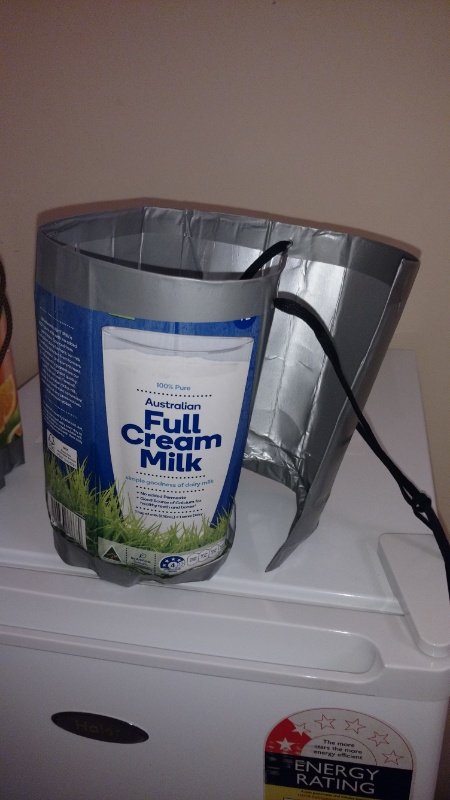
I walked in a long sleeve shirt, shorts or gym tights until Walpole, were I made some 'gaiters' from a pair of old tights and 4 cardboard milk cartons and string. Some of the trail was very narrow with scratchy bushes heading into Walpole and I was getting scratched on the legs a lot. Concerned this might continue on the coastal sections I made gaiters, but didn't find this was the case after Walpole. It very much depends on when the trail was last maintained. The section into Walpole hadn't been cut back recently - so the bushes were closer to the trail. I ended up wearing my gaiters some days, but not others. When making the gaiters I thought they could also be 'snake proof', based on how thick the material of the milk carton was. It was thicker and harder than gaiters others had purchased and were wearing. Though, I never saw a snake while wearing the gaiters.
Rain coat was a $4 plastic poncho with a garbage bag skirt. The poncho was put on and the pack put on over the top. Shoulder straps and hip belt stopped it billowing about. I did have a old Marmot rain jacket - that is no longer a waterproof - that I used as a coat under, or in high winds, over the plastic poncho. I also use this jacket to help with warmth in camp as another layer, or when it was windy as a wind block. I'd like to find a silnylon jacket - as it would be lighter, but as I have this Marmot jacket I use it. Besides its lack of waterproofness, it is in great shape for the many years I've had it.
Water filter. All the rainwater tanks had a warning about the water needing treatment. A lot of people drank without treating the water. They had various beliefs about why it was safe, and not necessary to treat the water. I used a Sawyer Squeeze and always filtered my water. There were a few other hikers that also treated their water. One had a Sawyer Mini. Comparing size and filtering speed, the Mini was significantly slower to filter for minimal weight savings. Given a choice, get the the Squeeze. I had an adaptor to backflush the filter with me, but didn't use it. A few times when the filter seemed to slow down I'd leave it attached to the bag and standing upright. So that water would drain backwards into the bag. Sometimes I'd even blow to push the water into the bag. I'd then discard this water. It seemed to help. In town I'd flush it under a tap using my hand as a connector. Online some overseas hikers reported that the Sawyer bags had failed for them. I carried a 1.25 PET bottle in case this happened. I suspect it depends on how the bags are treated. With the rainwater minimal effort was needed to filter the water, so I doubt they would have failed. A rat did chew holes in two of the bags at one shelter. I don't know if the rat was unable to chew the PET bottle, or gave up without trying.
I carried a trowel - a $3 children's garden trowel from Bunnings. Only used it once.