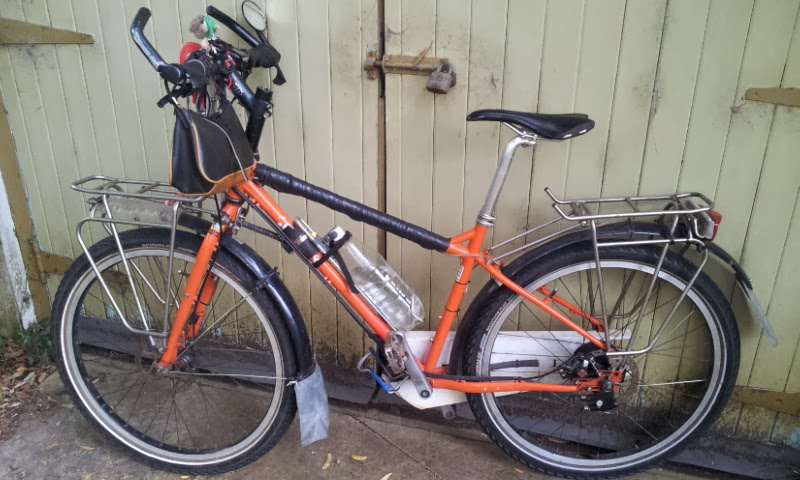
My fitness declined in the past year. I was reminded of this last week, when I rode from the city to Hornsby. I set out just before lunch, a couple hours, I'll eat when I get there. The first half was easy, then I started feeling tired. It was hot - the heatwave. The sensible thing would have been to stop, rest, have lunch, but I was focusing on arriving first. I pushed on, into the hills. Soon I hit the wall, and a little later while I was down, the wall fell on me. I was shattered. Even walking was an effort. I was so glad when I could lie down. I slept well that night.
Getting about everywhere by bike, its slowly coming back. All that incidental travel adds up. I'm helping it along by taking daily rides, gradually increasing the distances.
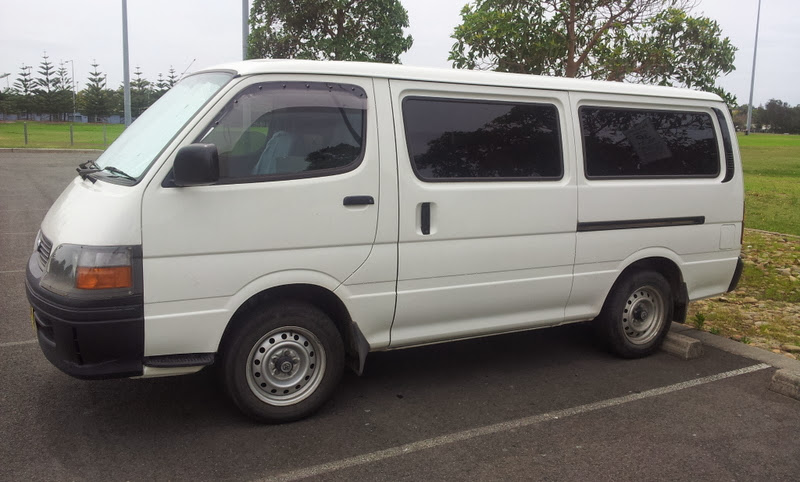
2004 Toyota Hiace van, 3L aspirated diesel engine, 5speed manual, 132000 km, tinted windows, alarm, engine immobiliser, 140W solar folding panel, 105 ahm AGM battery, CTEK 250S Dual charger, 600W full sine wave inverter
It'll be a few more days yet before I'm listing the van on the car sales websites, but the van is for sale.
Big changes are afoot. It is not new year resolution stuff. I've been thinking about this for the past few months. Just have been sitting on the idea and thinking a lot. Also, with Christmas and New Year happening, I thought that it was not the best time to be selling. I have used some of the time to start cleaning up. I've just spent part of today going through all the stuff I've accumulated, (How'd I get so much?) sorting it into heaps - going with me, going to sell, going to give away, going to trash.
So, selling the van - what next? A return to the bicycle and the tent. Time to hit the road again and keep exploring the country.
Why?
When I bought the van, I'd decided it was time for a change. I'd thought long and hard about it. Bike touring isn't always bliss and pleasure, sometimes its really hard. At the time, weighing up the data, giving everything equal weight, a van seemed the best decision.
Where I failed, was the weightings of those decisions comparing living in the tent and the van. It was hard to weigh some of them without having had lived in a van before. Now I have, and looking back on those decisions, I weigh them differently now.
There are many good points for living in a van. Certainly some people are very happy living in a van. But for me, I don't want to keep doing it.
If home is where the heart is, then my heart isn't in the van. Its outside, under the sky, in the wind, rain, fog and sun. Hearing the birds, and the rustle of wind in the trees. Feeling the rain drops on my face. Inhaling the sweet honey smell of the eucalyptus, sensing the cool riding into the morning mists. Its outside, active, being in the environment, rather than watching it pass by out the window.
I miss riding my bicycle.
Comments:
Date: 2014-01-22 16:31
Author: Kazzy
Hi, I'm Kazzy. Are you selling a beautiful Tyota Van?
This is a post I started late last year. Its been resting in 'Drafts' for some time. As part of the clean up for the end of this year, I've just finished the references and here it is:
I was looking my tube of toothpaste: Colgate Maximum Cavity Protection. There is a little drop with 'Liquid Calcium" written underneath the writing.
The claim of 'liquid calcium' had me thinking. It sounds like it is giving calcium to your teeth - which would be a good thing. But
Calcium melts at 842 Celsius
, so that claim is clearly not true. Maybe they mean that it provides calcium ions in solution when your brushing?
I decided to check this out. The "active" ingredients on the tube do not list calcium in it at all.
The fine print on the tube refers you to
www.colgate.com.au
for more information. But there is no more information shown for Colgate Maximum Cavity Protection.
Looking about the Australian site for Colgate, there isn't very much information besides the advertising spiel. Even for their Colgate Total range, which they did have an option for "more information" only gives more advertising speak.
For the Australian product:
INGREDIENTS Active:
Active Ingredients: per tube: Sodium monofluorophosphate 0.76% W/W, Sodium fluoride 0.10% W/W
The First ingredient is calcium. Dicalcium - looks promising.
Di, being the prefix meaning two. Twice the calcium? But, don't be fooled.
Before we start, a quick rundown on tooth decay.
Dental decay is when the rate of minerals lost from the teeth exceed the rate they are deposited. Bacteria break down foods, and release acid, which erodes the enamel causing minerals to be lost. Saliva washes the acid away, and provides calcium ions to replace the mineral lost, restoring the enamel. Acidic foods also demineralize the teeth, just like excessive vomiting. Tooth enamel can also be lost by excessive abrasion - brushing too often.
Looking at all the ingredients:
Dicalcium phosphate dihydrate
does not provide any calcium ions as its classed as practically insoluble in water. In toothpaste it used as a tartar control agent. What this means is that it is an abrasive. Rubbing between the toothbrush and your teeth will grind off any tartar.
It is used to provide a form of calcium in food: breakfast cereals, enriched flour and noodles. But the calcium here is available after digestive acids have acted on it.
Since
saliva
is 99.5% water, not much is going to dissolve.
Water
- Depends on the water. If its pure water its not going to have any calcium in it, but assuming its a normal drinking water source, it is a possibility that there might be some calcium in it. See below under 'flavour'. The water could have "processing aids" in it.
sorbitol
- Is a sugar substitute, a thickener, that also retains moisture.
sodium lauryl sulfate
- Used as a surfactant. Interestingly, a
study
has suggested that it could be decreasing the effectiveness of fluoride in toothpaste.
Reduces sweetness - as seen when having sweets after using toothpaste.
cellulose gum
- Also known as Carboxymethyl cellulose, but cellulose gum sounds better. Used as a thickener.
flavour - no idea what this is, as it is not required to be disclosed. Australia only requires that if a flavor or flavoring is used that it is
listed as 'flavouring' or 'flavour'
. Since the toothpaste is 'cool mint' flavour, its 'cool mint' of some sort.
Actually reading the Australian New Zealand food standards is an enlightening process. "Processing aids" do not have to appear in the ingredients list.
This standard
lists off all the acceptable aids used that don't have to be listed as an ingredient:
antifoam agents
catalysts
decolourants, clarifying, filtration and adsorbent agents
desiccating preparations
ion exchange resins
lubricants, release and anti-stick agents
carriers, solvents and diluents
processing aids used in packaged water and in water used as an ingredient in other foods
bleaching agents, washing and peeling agents
extraction solvents
enzymes of animal origin
enzymes of plant origin
enzymes of microbial origin
microbial nutrients and microbial nutrient adjuncts
Dimethyl dicarbonate as a microbial control agent
and finally processing aids with miscellaneous functions
Some agents have a limit for how much can appear in the food. For most of the agents, the amount used is listed as "GMP" (Good Manufacturing Practice). I cannot find a definition of that, but it seems to be to only use enough to get the job done. I didn't find anything that said how much that is either.
Sodium monofluorophosphate
is the active ingredient, and is providing fluoride ions. It has been found that fluoride in the remineralization makes a more acid resistant enamel. So this is not a bad thing. The amount in toothpaste is less than 1%. Each 175 gram tube has 1.3 grams in it. Not much.
Makes me wonder just how much are you getting when using a small amount of toothpaste.
tetrasodium pyrophosphate
- is used as a buffering agent, an emulsifier, a dispersing agent and a thickener.
In toothpaste its used for tartar control by removing calcium and magnesium from saliva to stop them being deposited on the teeth.